Showing posts with label Iran.. Show all posts

Saturday, September 9, 2017

AFTER HER ELECTION AS PMOI/MEK SECRETARY GENERAL, ZAHRA MERRIKHI PLEDGES TO BRING FREEDOM TO IRAN


Masoud Dalvand –TDO-(AMERICA) The People’s Mojahedin Organization of Iran, PMOI, (the Mujahedin-e Khalq, MEK) held its annual Congress simultaneously in Tirana and five other countries. On the PMOI’s 52nd anniversary, the Congress elected Ms. Zahra Merrikhi as its new Secretary General. Ms. Zohreh Akhyani, the Secretary General since 2011, chaired the Congress.
According to the PMOI’s bylaws, the Secretary General is elected to a renewable term of two years. The election is held in three phases. In the first phase, members of the PMOI Central Council, and in the second the organization’s officials and cadres in different departments, cast their votes in secret ballots. In the third phase, at the PMOI Congress, all members vote by raising their hands.
In the first phase, on August 20, 2017, Ms. Merrikhi was elected from among 12 candidates by a majority of the Central Council members. The four leading candidates were put on the ballot for the second phase, which was held on September 3, 2017. Ms. Merrikhi received a majority of the votes cast in ten different PMOI centers. In the final phase, during the PMOI Congress, Ms. Merrikhi was unanimously elected Secretary General.
Previously, Ms. Merrikhi was coordinator for the offices of Mrs. Maryam Rajavi, the President-elect of the National Council of Resistance of Iran (NCRI), and Vice-President of the PMOI’s Central Council.
Born in 1959 in the city of Qa’emshahr in the northern Province of Mazandaran, Ms. Merrikhi became acquainted with the PMOI during the 1979 anti-Monarchic Revolution and joined the PMOI after the Shah’s overthrow. She was soon appointed head of the women’s section in Qa’emshahr, and later became a member of the editorial board of the PMOI publication in Mazandaran, called Talavang.
In 1981, she was transferred to Tehran and acted as liaison between the PMOI and its branches in the forests of northern Iran. In 1984, she moved to PMOI bases in the border region with Iraq, and a year later became a member of the Central Council.
Her younger brother, Ali Merrikhi, was murdered by the Islamic Revolutionary Guards Corps (IRGC) in 1988.
Ms. Merrikhi oversaw PMOI branches in Scandinavia and Germany for some time. In 1991, she became a member of the Executive Committee and was later appointed head of Radio Mojahed, Simay-e Moghavemat (the Iranian Resistance’s television network) and the publication Mojahed.
She became a member of the NCRI in 1992 and was appointed Chairwoman of the Public Affairs Committee.
Ms. Merrikhi had been the coordinator of the offices of Mrs. Rajavii since 2003 and the Vice-president of the PMOI’s Central Council since 2004.
Following her election as Secretary General, Mrs. Merrikhi was sworn in, placing her hand on the Holy Quran and paying her respects to the Iranian flag and PMOI emblem. She pledged to remain faithful to the enormous responsibilities with which she has been entrusted. Ms. Merrikhi vowed to devote all her abilities and those of the PMOI as a national treasure of the Iranian people, to establish freedom and democracy in Iran.
The new Secretary General expressed her appreciation for the efforts of her predecessor, Ms. Akhyani, and Ms. Mojgan Parsai, the President of the PMOI’s Central Council. She lauded their efforts and those of other PMOI officials over the past 14 years, during one of the most dangerous and tortuous periods of the Organizations history in camps Ashraf and Liberty.
“Today, the PMOI, with the help of the Iranian people, is prepared as never before to overthrow the clerical regime,” Ms. Merrikhi said, adding that the PMOI has now 18 co-Secretaries General (including seven former Secretaries General). Ms. Merrikhi also introduced Narges Azodanlou, 36, Rabi’eh Mofidi, 35, and Nasrin Massih, 39, as new deputies to the Secretary General.
In congratulating the election of Ms. Merrikhi as the new PMOI Secretary General, Mrs. Rajavi described it as a brilliant election, embodying the height of democracy, cohesion, and growth in the PMOI. It heralds the breaking of the spell of repression which will lead to the overthrow of the religious fascism ruling Iran, she added.

    IRANIAN OPPOSITION ELECTS NEW SECRETARY GENERAL


    Masoud Dalvand –TDO- (AMERICA) At its annual congress held in Tirana, Albania, principal Iranian opposition group People’s Mojahedin Organization of Iran (PMOI/MEK) elected Ms. Zahra Merrikhi as its new Secretary General. Ms. Merrikhi will be replacing Ms. Zohreh Akhyani, who had been holding the position since 2011.
    The PMOI’s Secretary General is elected for a renewable two-year term. The elections are held in three phases. In the first phase, members of the organization’s Central Council cast their votes in ballot boxes to specify their candidates. The second phase is held with the participation of all of PMOI’s cadres, who cast their votes in their respective departments. The final phase is held at the organization’s annual congress, where all members confirm the new Secretary General by raising their hands.
    Ms. Merrikhi, who has a decades-long career fulfilling different responsibilities in the Iranian resistance, earned the majority of the vote in the first two phases and was sworn in as the new Secretary General after receiving collective confirmation from PMOI members in the September 6 congress.
    Ms. Merrikhi hails from the city of Qa’emshahr in northern Iran. Born in 1959, she joined the PMOI after the 1979 revolution, after the overthrow of the Shah regime.
    Prior to her new position, Ms. Merrikhi was the coordinator of the offices of Mrs. Maryam Rajavi, the President-elect of the National Council of Resistance of Iran (NCRI), a coalition of opposition forces that the PMOI belongs to. She’s also the deputy chief of the PMOI’s Central Council.

    Ms. Merrikhi has been actively involved in the Iranian resistance’s media and broadcasting efforts. She joined the editorial board of Talavang, a PMOI publication in Mazandaran, shortly after joining the organization. She has also served a stint as the head of Radio Mojahed and Simay-e-Moghavemat, the news broadcasting network of the Iranian resistance.
    In 1981, after the Iranian regime banned the PMOI, Ms. Merrikhi moved to Tehran, where she coordinated communications between the capital and its branches that were deployed in Iran’s northern branches. In 1984, she joined the PMOI bases in the Iran-Iraq border region, and was soon afterwards promoted to the organization’s Central Council.
    Her brother Ali was murdered by the Iranian regime’s Revolutionary Guards (IRGC) in 1988.
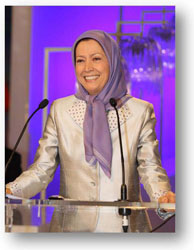
    While expressing her appreciation for the efforts of her predecessors, Ms. Merrikhi vowed to remain true to the PMOI’s goal of establishing freedom and democracy in Iran. “Today, the PMOI, with the help of the Iranian people, is prepared as never before to overthrow the clerical regime,” Ms. Merrikhi said.


    Mrs. Rajavi the president elect of the National Council of Resistance of Iran (NCRI), welcomed the election of Ms. Merrikhi as the new Secretary General, and described it as heralding the breaking of the spell of repression which will lead to the overthrow of the religious fascism ruling Iran.


    Tuesday, August 22, 2017

    Time for Regime Change in Iran


    By Peter Paton
    persiaIt is time for America, the West and democratic Arab countries to bring Regime Change in Iran, and sow the seeds of Resistance in Iran by encouraging, inspiring and supporting Uprising and Insurrection in Iran against the despotic Ayatollah Khamenei and his autocratic Mullahs. It may well be the only way to prevent a strike by the Israelis on Iranian nuclear assets, who fear nuclear weapons in the hands of the Mad Mullahs, will lead to another Holocaust of the Jewish Race.
    The West and its Allies should begin waging a Propaganda War to initiate an Iranian Resistance Army front against Khamenei and the Mullahs to bring about REGIME CHANGE IN IRAN, to liberate the Iranian people from the mass murder, rape, robbery and enslavement imposed upon ordinary Iranians by the hard line Islamic rulers and barbaric Sharia Law. By terminating the Mullah Regime in Tehran, America and the West would be cutting off the head of the Islamic snake, which in turn would give inspiration and courage to the Iranian people to fight against their barbaric oppressors, and encourage the Iranian Military to defect to the Free Iranian Army, and greatly reduce the risk of collateral damage to innocent Iranian civilians.
    10point-plan-rajaviAnd this time America and the West must show total support and solidarity with the Persian people. Maryam Rajavi is the People’s Choice to be the President Elect of Iran once the Mullah Regime is overthrown.
    Iranians are a very diverse people, only about 50% are Persian; the rest are Baloch, Turcman, Kurd, Azeri and Arabs. Millions of Iranians have fled Iran; tens of thousands have been massacred; people shot dead in streets; hanged and women debased and brutally raped under the cruel and medieval rule of the Ayatollah Khamenei and President Mahmoud Ahmadinejad.
    iran 1America and the West should step up its campaign of destabilizing Khamenei and the Mullahs by means of Satellite TV Channels of bringing the Truth and Hope direct to the Iranian people,  sabotage, electronic jamming and bugging of its military and nuclear facilities, and increasing the severity of economic sanctions on the Islamic Regime. By provoking Insurrection in Iran, the West would redress the balance that been tilting in favor of the Iran/China/Russian Axis, terminate the nuclear quest and despotic rule of the Mullahs, and start the process of freeing Iranians from Radical Islam and Sharia Law, and return Iran to Persian and Secular Rule.
    Peter Paton is an International PR and Strategic Adviser
    Follow Peter on Twitter @pjpaton

    Saturday, August 19, 2017

    WHAT IS THE MESSAGE OF THE US SENATORS VISIT WITH MRS. MARYAM RAJAVI AND THE MEMBERS OF THE PMOI/MEK FOR IRAN?


    By Mahdavi nasim
    Last week, a panel of US senators headed by Roy Blunt arrived in Tirana and met with Mrs. Maryam Rajavi, leader of the National Council of Resistance of Iran(NCRI) and members of the People's Mojahedin Organization(PMOI/MEK).
    The Senate delegation consisted of Senators Roy Blunt, Vice President of the Republican Conference, and member of the Appropriation, Select Intelligence, Rules and Administration, and Commerce, Science, and Transportation committees; John Cornyn, the Majority Whip, and a member of the Judiciary, Select Intelligence, and Finance committees; and Thom Tillis, a member of the Armed Services, Judiciary, Banking, Housing and Urban Affairs and Veterans’ Affairs committees.
    During this meeting, the situation of the members of the PMOI/MEK in Albania, the latest situation in Iran and the region, and solutions to end the crisis in the region were discussed, American senators welcomed the relocation of PMOI/MEK members of Camp Liberty in Iraq to Albania .It should be remembered that the last group of members of the People's Mojahedin Organization of Iran(PMOI/MEK), who lived in Camp Liberty near Iraq, was relocated to Albania last year.
    Maryam Rajavi thanked the Senators for their decisive position vis-à-vis the Iranian regime, especially the adoption of a new resolution which imposed sanctions on the clerical regime and the Islamic Revolutionary Guards Corps (IRGC) for human rights abuses, the ballistic missile program, and the export of terrorism.
    Maryam Rajavi emphasized that contrary to the propaganda by the Iranian regime’s apologists, the ruling theocracy was rotten to the core and very fragile. Without foreign support, especially the policy of appeasement pursued in the U.S. and Europe, it would not have survived so long. She added that regime change in Iran is necessary and within reach because a viable and democratic alternative exists. Maryam Rajavi said equating regime change by the Iranian people for democracy with war and instability in the region is a sheer lie, the source of which is the Iranian regime’s lobby in western capitals. They demagogically turn the truth on its head, she noted, adding that the overthrow of the Tehran regime was a prerequisite to ending crisis and war in the Middle East.
    Maryam Rajavi underscored the need for expelling the IRGC and its affiliated militias from Syria, Iraq, and other regional countries, taking urgent steps to punish the regime for widespread political executions, especially the 1988 massacre of 30,000 political prisoners.
    It should be remembered that this meeting was just three weeks after the adoption of strong US sanctions against the Iranian regime and black list of the Islamic Revolutionary Guard Corps (IRGC), there is a strong message to the Iranian regime that conditions have changed and the winds do not blow the interests of Iran, But now the winds are in the interests of the PMOI/MEK, And this group has a special status as the only group and democratic alternative in the international community and among politicians, especially American politicians. Of course, it should not be forgotten that the PMOI/MEK, despite the conspiracies and the desire of the regime to destroy them, were able to keep their organization, which are now at the forefront of a resistance movement to overthrow this regime.
    The Iranian regime probably understands the meaning of this visit, because it knows that the issue of regime change is not just the desire Iranian people, but it is also a regional demand. The regime also knows that due to its destructive activities in the region, particularly its support for Syrian dictator Bashar al-Assad, its support for the Houthi fundamentalist group in Yemen, as well as its active financial and arms support for Lebanon's Hezbollah all the countries in the region oppose it, Therefore, the policy of regime change has become an international and regional demand.


    CALL FOR AN INTERNATIONAL COMMISSION OF INQUIRY TO INVESTIGATE 1988 MASSACRE OF 30,000 POLITICAL PRISONERS IN IRAN


    Human rights, in particular, bringing to justice the officials involved in the 1988 massacre, should be at the core of Iran policyHuman rights defenders, dignitaries, European politicians and the Iranian Resistance called for the formation of an international commission of inquiry into the massacre of political prisoners in Iran in the summer of 1988 and bringing those responsible for this genocide and crime against humanity to justice.
    They stressed that the issue of human rights should be at the core of the West’s policy on Iran. They urged the UN, EU and the US to put the issue of flagrant and systematic violation of human rights in Iran on top of their agenda.
    The call was made during an exhibition on the 1988 massacre that took place upon the initiative of Mr. Jean-François Legaret, the Mayor of Paris municipality District 1 at this municipality on Thursday, August 17, 2017.
    In addition to Mr. Legaret, several French mayors including Armand Jacquemin, mayor of Moussy Le Vieux, Jean-Claude Jegoudez, mayor of Grisy-Sur-Seine, and Jacky Duminy, mayor of Ors took part and spoke at the exhibition.
    Mrs. Maryam Rajavi, the President-elect of the Iranian Resistance, in a message to the exhibition said 30,000 political prisoners were hanged in Iran in days such as these in the summer of 1988, without any reaction by Western governments.
    Those who remained silent over this tragedy betrayed humanity because the mullahs found out that their crimes had no consequences. So, they continued by exporting their terrorism and fundamentalism abroad and drenching the Middle East in blood.
    If in those days, the massacre had not been met with silence, today, the mullahs could not sink Syria in a whirlpool of blood.
    The people of Iran want to end the impunity of those in charge of the massacre and hold them accountable. This has turned into the Iranian people’s most important political demand from the clerical regime. We urge the UN High Commissioner for Human Rights to set up an independent commission of inquiry to investigate the 1988 massacre. The UN Security Council must set up a special tribunal or refer the issue to the International Criminal Court to arrange for the prosecution of the leaders of the Iranian regime.
    Mrs. Rajavi once again urged all governments to make their relations and trade with the religious fascism ruling Iran contingent on an end to executions and torture.
    Governor Yves Bonnet, the former head of France’s domestic anti-terrorism organization; Struan Stevenson, a Scottish politician, President of “European Iraqi Freedom Association” and former President of the European Parliament’s Delegation for Relations with Iraq, were among the dignitaries who took part in this exhibition and supported the call by the head of the opposition.
    In his remarks, Stevenson condemned the recent trip of EU foreign policy chief Federica Mogherini to Iran and said: “Rouhani has been hailed in the West as a moderate and a reformist, despite the fact that more than 3,500 people, including 80 women, have been executed during the four years he has been in office, catapulting Iran into pole position as the world’s number one state executioner per capita. Several hundred people have been executed so far this year, including women and teenagers. Three days before Mogherini arrived in Tehran, Amnesty International published a 94-page report highlighting the ‘web of oppression’ that pervades Iran and detailing the catastrophic human rights situation in the country.”

    He added: “The French government and the EU should also be demanding a full United Nations inquiry into the 1988 massacre, with Khamenei, Rouhani and their clique of killer clerics indicted for crimes against humanity and brought for trial before the international courts in The Hague.”
    Khomeini, the founder of the clerical regime in the summer of 1988, in a fatwa that was unprecedented in the history of Islam, stated that all those who were imprisoned throughout Iran and were still loyal to the People’s Mojahedin Organization of Iran should be executed. More than 30,000 political prisoners who were serving their terms were executed in a few months based on this criminal fatwa. The Death Commissions, in trials that lasted just a few minutes, sent to the gallows any of the prisoners who were not willing to condemn the PMOI (MEK). The victims were buried in mass graves in secret.

    In spite of the mullahs’ attempts to impose silence on this crime against humanity and to prevent the spread of this issue in the society, the movement calling for justice for the victims of the massacre in Iran has expanded since last year and has evolved into a public issue. The Justice seeking movement in Iran managed to corner the mullahs.
    Ali Khamenei intended to put a member of the 1988 massacre’s Death Commission in the office of president, but the nationwide campaign calling for justice foiled his plans.
    During the last year, new information about the slaughter, including a large number of names of the victims, as well as the locations of numerous mass graves which the mullahs had previously concealed, has surfaced.
    The 1988 massacre and the conspiracy of silence has been an issue of consensus among the regime’s various factions and its senior officials.
    Over the past four years, the mullahs’ president Hassan Rouhani had appointed Mostafa Pour-Mohammadi, one of the key officials in charge of the 1988 massacre, as Minister of Justice. The new Justice Minister for his second term, Alireza Avaie, is another one of the perpetrators of the massacre, who has been already designated as a violator of human rights by the European Union.
    A number of relatives of the victims and individuals who spent years in prison in Iran and were tortured shared their observations with the audience during the exhibition.


    US TIES WITH IRANIAN OPPOSITION STRENGTHENING


     by :Dr. Majid Rafizadeh
    The Iranian opposition is gaining momentum due to a growing consensus in the US Congress over the necessity for regime change in Iran. A senior delegation of US senators went to Albania’s capital Tirana this week to meet Maryam Rajavi, who heads the National Council of Resistance of Iran (NCRI), a political coalition calling for regime change in Iran and considered the main threat to the ruling mullahs. 
    They also met members of the People’s Mojahedin of Iran (MEK), the main member of this varied coalition of groups and individuals. The high-profile visit comes at a time when Washington has slapped major new sanctions on Iran, including its Revolutionary Guard Corps (IRGC), for its ballistic missile drive, its support for terrorism and its human rights violations. Given that the IRGC controls over 40 percent of Iran’s economy, these new sanctions are a heavy blow to Tehran’s ambitions.
    Ties between Iran’s opposition and US officials are strengthening, and the number of high-level officials supporting the opposition is rising. They recognize the opposition as a legitimate representative of many Iranians who seek democracy in their country. Rajavi expressed her gratitude for the US Senate’s tireless efforts to protect thousands of MEK members in Iraq and relocate them to Albania.
    Previously, in a Senate briefing, several US officials strongly condemned Iran’s destructive role in Iraq. Sen. Roy Blunt joined an initiative demanding the urgent transfer of MEK members stationed in a former US military base known as Camp Liberty near Baghdad. 
    In April, Sen. John McCain, a longtime supporter of the Iranian opposition, visited the MEK in Albania and met with Rajavi. MEK members were able to leave Iraq after a four-and-a-half-year ordeal in Camp Liberty following their forced transfer from their 26-year home in Camp Ashraf, northeast of Baghdad.
    From 2009, following the transfer of security from the US military to the Iraqi government, the MEK came under eight major ground and rocket attacks by Iran-backed proxies against Ashraf and Liberty. This was in parallel with a seven-year siege. After losing more than 160 of their colleagues to the attacks and blockade, MEK members were finally able to leave Iraq for European countries, mainly Albania.
    This latest visit sends a strong signal to Tehran that the NCRI is gaining momentum. This time last year, Tehran was hell-bent on destroying the MEK. Now the tide has turned, with the opposition on the offensive.
    Tehran fears the opposition’s soft power more than the hard power of foreign governments. That is why Iranian leaders and media outlets react forcefully and anxiously to such visits and opposition activities. The opposition can be a very powerful tool to pressure Tehran without the need for direct military confrontation.


    ALL THE PRESIDENT’S MEN: IRAN’S CABINET CANDIDATES


    While humans lack the ability to see into the future, we do possess the power to analyze our world to predict what the future has in store for us. The result of Iran’s so-called presidential election back in May rendered a second term for the incumbent Hassan Rouhani. During Iran’s short election season, lasting no less than a month, the mullahs’ cunningly downgraded crackdown measures,
    decreasing executions and increasing social freedoms to lure the general public into polling stations.
    Nevertheless, the all-male slate of cabinet candidates presented by Rouhani to the parliament for approval provides a dark insight of what awaits the Iranian people and the international community. To make a long story short, these are names consisting of former Revolutionary Guards (IRGC) members, hostage takers, executioners, torturers and thieves.
    This is a signal of Iran fueling a future of further wars, crackdown, massacres, exporting terrorism and fundamentalism, and killing sprees targeting the region’s nations.
    While Iran apologists and the appeasement camp misled the international community to naively describe Rouhani as a smiling “moderate,” his first term rendered over 3,000 executions and went mostly neglected. Knowing the Obama administration desperately needed a legacy-defining foreign policy achievement, Rouhani and the mullahs saw a green light to press the gas pedal on executions.
    After deactivating the gallows shortly for the May elections, the mullahs returned to their true nature and resorted to over 100 executions in July alone. This consists of an average of at least one execution every eight hours.
    This should be a wake-up call for European states that have banned executions altogether, and yet are willing to signature lucrative economic deals with Tehran, such as Airbus, Total and Renault.
    Rouhani’s list of cabinet candidates has raised quite a stir. After providing a variety of promises during his election campaign, he failed to present even a single female minister candidate. Only under a wave of protests and pressures did Rouhani give in to naming three female vice presidents, providing nothing more than symbolic roles.
    There are also reports indicating Rouhani ran through his candidates in close coordination with Iranian Supreme Leader Ali Khamenei. This goes against Iranian political norms — Khamenei is known to have a say in a number of specific candidates, including the key ministers of defense, foreign affairs and intelligence.
    Anger mounted during his first term over Rouhani’s ironic decision to appoint Mostafa Pourmohammadi as his justice minister. Pourmohammadi is known for his direct role in the notorious 1988 massacre of over 30,000 political prisoners, mostly members and supporter members of the Iranian opposition People’s Mojahedin Organization of Iran (PMOI/MEK).
    And while Pourmohammadi is set aside in Rouhani’s second term cabinet, his replacement, Alireza Avaie, is adding insult to injury. Avaie also played a leading role in the 1988 massacre in Khuzestan Province, southwest Iran. The Iranian opposition National Council of Resistance of Iran (NCRI) held a press conference in September unveiling Avaie’s involvement in executions of Younesco Prison in the city of Dezful. The majority of Iran’s Arab community are resident in the country’s southwest regions.
    Other names in Rouhani’s cabinet indicate a bleak second term riddled with crackdown measures and going back on all election season promises.
    Mohammad Javad Azari Jahromi is appointed to serve as the new minister of communications and information technology. This is an individual who entered the mullahs’ hated Ministry of Intelligence (MOIS) at the age of 21, becoming involved in interrogations, torture and censorship in his early days.
    During the 2009 uprising Jahromi was appointed as the MOIS Director of Surveillance. He is known to have expanded this department and his appointment is seen as Rouhani’s attempt to confront the PMOI/MEK’s increasing popularity amongst Iran’s population through social media networks. Iran is known to have a young and very active social media population of over 40 million users.
    Amir Hatami is set to become Iran’s new defense minister. Joining the ultraconservative and repressive IRGC Bassij paramilitaries at the age of 12, Hatami is known for his active and enthusiastic participation in the regime’s crackdown and killing campaigns. He is amongst the Bassij members tasked to join Iran’s classic army and quickly rose the ranks to provide the mullahs the influence they sought in this force. Hatami also played an important role in identifying, arresting and eliminating any army member showing even the slightest sign of patriotic devotion and acting against the mullahs’ interests.
    Habibollah Beetaraf, Rouhani’s candidate for the new labor minister, was amongst the so-called “college students” who stormed the US Embassy back in 1979 and took 52 American diplomats hostage. He was one of the first IRGC members and participated in literally herding teenagers and even small children into minefields during the Iran-Iraq War of the 1980s.
    Iran’s industry, mines and trade will be managed by Mohammad Shariatmadari, famous for actively playing a part in the regime’s crackdown and plundering. He is heavily involved in managing Khamenei’s conglomerate, known as the “Setad Ejraiye Farmane Hazrate Emam” – Headquarters for Executing the Order of the Imam, controlling a large percentage of the regime’s economic empire. $95 billion is this massive entity’s estimated capital.
    This lineup provides a dark glimpse into what the future will bring for the Iranian people and neighboring nations. For example, following July’s execution spree, the mullahs’ regime reportedly sent 13 individuals to the gallows on August 10th alone.
    This atrocity included 11 hangings in a mass killing in the city of Birjand, eastern Iran; one execution in a small town in northern Iran; and the horrific execution of 20-year-old Alireza Tajiki, arrested at the age of 15 at the time of his alleged crime.
    Amnesty International demanding Tehran halt this hanging fell on deaf ears and Iran’s mullahs once again proved their sinister cruelty and lack of respect for any humane values and international laws.
    Rouhani’s second term will bring nothing but additional economic and social devastation, parallel to political crackdown, destructive meddling across the region and continuing Iran’s ballistic missile/nuclear drives. Rouhani neither has the will nor intention to bring about any meaningful change in this regime’s foundations, infrastructure, nature or approach.
    What else is expected from an individual who for 40 years has actively participated in the regime’s oppression and warmongering. Rouhani was the first Iranian regime official to call for public executions to teach the Iranian people a lesson.
    Despite claims otherwise, Rouhani is part and parcel of the mullahs’ establishment, and he, too, seeks to maintain this system intact and in power. Hence, the international community needs to understand no change will emerge from this medieval, reactionary-minded regime.
    The Iranian people and their organized opposition finally deserve the support and recognition they have been deprived of for the past four decades.

    Thursday, August 17, 2017

    Senior US Senators Meet Iran Opposition Leader In Albania


    NCRI
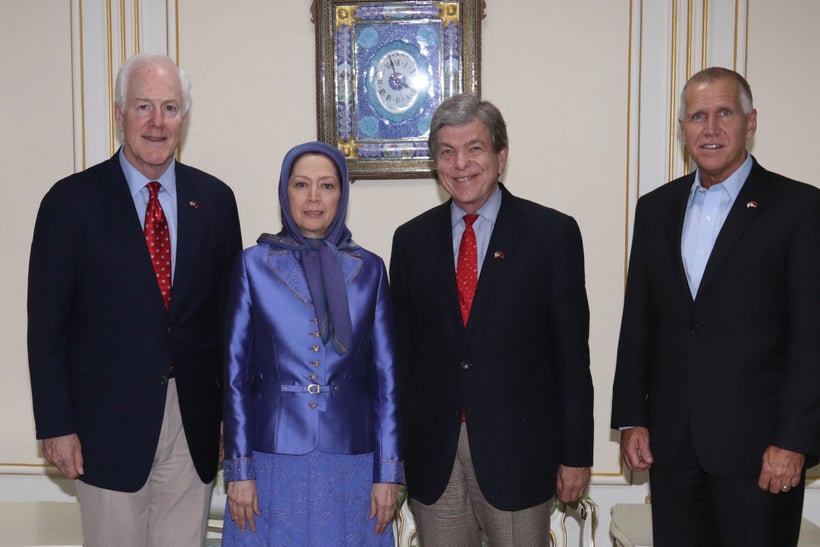
    Tirana, Albania, August 12, 2017 - Mrs. Maryam Rajavi (left), the President-elect of the National Council of Resistance of Iran meeting a senior delegation from the United States Senate. The two sides discussed the situation of members of the Mujahedin-e Khalq in Albania and the recent developments in Iran and the Middle East.
    While August seems usually a passive time of the year in politics, it has been quite the opposite for Iran and the wide variety of developments around this controversial international dossier.
    A senior delegation of United States Senators travelled to Tirana, the capital of Albania, today, August 12, 2017, to meet the Iranian opposition leader Maryam Rajavi, who heads the National Council of Resistance of Iran.
    The delegation, Senators Roy Blunt, Vice President of the Republican Conference, and member of the Appropriation, Select Intelligence, Rules and Administration, and Commerce, Science, and Transportation committees; John Cornyn, the Majority Whip, and a member of the Judiciary, Select Intelligence, and Finance committees; and Thom Tillis, a member of the Armed Services, Judiciary, Banking, Housing and Urban Affairs and Veterans’ Affairs committees, also visited members of the People’s Mojahedin Organization of Iran (PMOI/MEK) in the Albanian capital.
    NCRI
    Tirana, Albania, August 12, 2017 - Mrs. Maryam Rajavi (center), the President-elect of the National Council of Resistance of Iran meeting a senior delegation from the United States Senate. From right: Senators Thom Tillis (R-NC), Roy Blunt (R-MO), and John Cornyn (R-TX).
    The NCRI is a political coalition calling for regime change in Iran and considered the main threat to Tehran’s mullahs. The MEK is the main member of this coalition of a variety of Iranian dissident groups and individuals.
    “Led by Senator Blunt, the delegation congratulated the safe and secure relocation of all Camp Liberty residents outside of Iraq and wished them success in their struggle for democracy and human rights in Iran,” according to an NCRI statement.
    Rajavi expressed her gratitude for the tireless efforts of the U.S. Senate, particularly Senator Blunt, regarding the protection of thousands of MEK members in Iraq, and their safe relocation to Albania.
    Senator Blunt was among several American dignitaries, including senior former officials, who at a July 2014 Senate briefing strongly condemned Iran’s highly destructive role in Iraq. While describing Tehran as part of the problem plaguing Baghdad and the entire country, Senator Blunt joined the initiative in demanding the urgent transfer of PMOI/MEK members stationed in a former US military base known as Camp Liberty near the Iraqi capital.
    Senator Blunt and his colleagues John McCain (R-AZ) and Jeanne Shaheen (D-NH), and former Senator Carl Levin had urged former Secretary of State John Kerry to “press for the protection of Camp Liberty and to expedite the resettlement of the Camp Residents to countries outside Iraq, including the United States.”
    NCRI
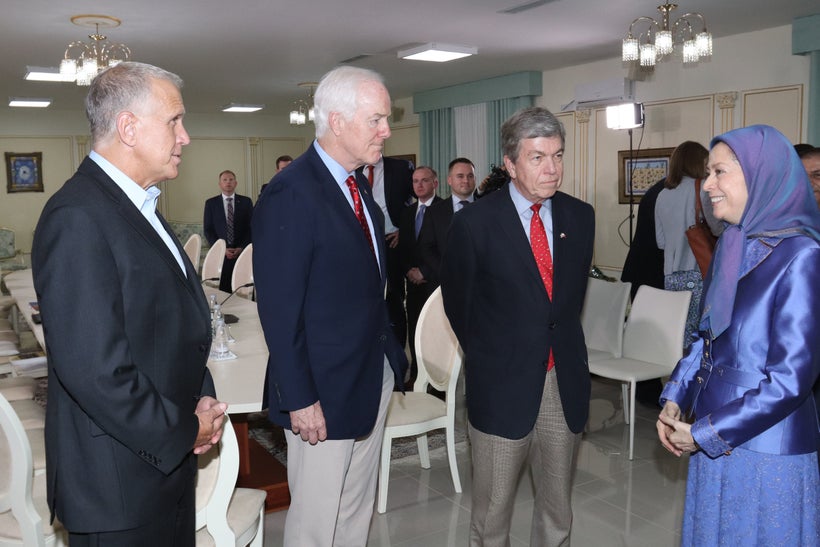
    Tirana, Albania, August 12, 2017 - Mrs. Maryam Rajavi (center), the President-elect of the National Council of Resistance of Iran meeting a senior delegation from the United States Senate. From right: Senators Roy Blunt (R-MO), John Cornyn (R-TX), and Thom Tillis (R-NC).

    source : Senior US Senators Meet Iran Opposition Leader In Albania

    وطن امروز: ایران، پاسپورت پیشکش، اعتبار گذرنامه سبز هم رفت

    ایران: پاسپورت پیش کش اعتبار گذرنامه سیز هم رفت  پاسپورت پیشکش اعتبار گذرنامه سبز هم رفت روزنامه حکومتی وطن امروز وابسته به باند ...