INU - There are many around the world who are pondering what the correct diplomatic response to the Iranian Regime should be and even those at those in charge of foreign policy aren’t entirely sure, given Secretary of State, Rex Tillerson’s recent comment that the US’s Iran policy is “under development.”
Tillerson said: “It’s not yet been delivered to the president, but I would tell you that we certainly recognize Iran’s continued destabilizing presence in the region, their payment of foreign fighters, their export of militia forces in Syria, in Iraq, in Yemen, their support for Hezbollah. And we are taking action to respond to Iran’s hegemony. Additional sanctions actions have been put in place against individuals and others.”
He continued: “We continually review the merits both from the standpoint of diplomatic but also international consequences of designating the Iranian Revolutionary Guard in its entirety as a terrorist organisation. As you know, we have designated the Quds [Force]. Our policy towards Iran is to push back on this hegemony, contain their ability to develop obviously nuclear weapons, and to work toward support of those elements inside of Iran that would lead to a peaceful transition of that government. Those elements are there, certainly as we know.”
Despite Donald Trump’s consistent statements that he does not trust the Regime, that they sponsor terrorism, and that they are a destructive influence on the Middle East, his administration still can’t agree on a firm policy towards them.
Luckily, Jubin Katiraie, an expert in Iranian affairs, wrote an op-ed for
Iran Focus in which he assessed that the right policy for Western lawmakers to adopt over Iran was to support the main opposition to the Regime.
Katiraie noted that the people of Iran are seeking Regime Change but the international community’s policy of appeasement towards the Regime along with the Regime’s suppression have made it incredibly hard to overthrow the Regime.
However, Iran has an organised democratic resistance (MEK) which has been around for nearly 40 years, despite constant attempts to exterminate them by the Regime.
Katiraie wrote: “Since June 20, 1981 Iranian regime has executed over 120000, mostly members and supporters of the MEK. Only in summer of 1988 over 30000 political prisoners, the majority of them from the MEK, were massacred. During this massacre the death committee was going to the prisons and asking the prisoners if they are still supporting the MEK, and if the answer was yes, they would immediately be hanged.”
The Regime’s attempts to do away with opposition continue to the present day, they still imprison members of the MEK and even family members of MEK supporters who are in exile. But the MEK and their supporters have persisted, disrupting the sham elections with banners advocating the Resistance and its leader Maryam Rajavi as the true opposition to the Regime and staging a campaign to get justice for their fallen members who were slaughtered in the 1988 massacre.
Katiraie wrote: “The campaign has been so widespread and extensive that last week Khamenei, the supreme leader of the regime was forced to react against the MEK, defending the massacre of MEK members and supporters in the prisons.”
This has led to the Regime-affiliated lobbies in Western countries to dig up long debunked rumours of terrorism and murder by MEK members. In fact, the MEK are more likely to be the victims of murder and terrorism from the Regime than the other way around.
Katiraie wrote: “ In this campaign they deceitfully do not directly support the regime, but instead by demonizing the MEK, they are trying to say that this regime does not have any alternative so for any possible change, the solution is within the regime and the West must try to find “moderates” inside the regime. The deceptive tactic is to save the same regime with the same values, and the right policy is to ignore all these propaganda of demonising the MEK by the Iranian regime and its lobbies. The basis for any right policy towards Iran is to officially recognise the MEK as the main opposition to this regime.”
More about the People’s Mojahdin Organization of Iran (PMOI/ MEK)
The People’s Mojahedin Organization of Iran (Also known as MEK, or Mujahedin-e-Khalq / Mujahedeen-e-Khalq), was founded on September 6, 1965, by Mohammad Hanifnejad, Saeed Mohsen, and Ali-Asghar Badizadgan. All engineers, they had earlier been members of the Freedom Movement (also known as the Liberation Movement), created by Medhi Bazargan in May 1961.
The MEK’s quest culminated in a true interpretation of Islam, which is inherently tolerant and democratic, and fully compatible with the values of modern-day civilization. It took six years for the MEK to formulate its view of Islam and develop a strategy to replace Iran’s dictatorial monarchy with a democratic government.
MEK’s interpretation of Islam
The theocratic mullah regime in Iran believe interpreting Islam is their exclusive domain. The MEK reject this view and the cleric’s reactionary vision of Islam. The MEK’s comprehensive interpretation of Islam proved to be more persuasive and appealing to the Iranian youth.
MEK’s founders and new members studied the various schools of thought, the Iranian history and those of other countries, enabling them to analyze other philosophies and ideologies with considerable knowledge and to present their own ideology, based on Islam, as the answer to Iran’s problems.
MEK’s leadership’s arrest during the 70s.
The Shah’s notorious secret police, SAVAK, arrested all MEK leaders and most of its member’s in1971. On May 1972, the founders of the MEK, Mohammad Hanifnejad , Saeed Mohsen and Ali Asghar Badizadegan, along with two members of the MEK leadership, Mahmoud Askarizadeh and Rasoul Meshkinfam, were put before death squads and were executed after long months of imprisonment and torture. They were the true vanguards, who stood against the dictatorial regime of Shah. However, they are also recognized for their opposition to what is today known as Islamic fundamentalism.
The death sentence of Massoud Rajavi, a member of MEK’s central committee, was commuted to life imprisonment as a result of an international campaign by his Geneva based brother, Dr. Kazem Rajavi (assassinated in April 1990 in Geneva by mullahs’ agents) and the personal intervention of the French President Georges Pompidou and Francois Mitterrand. He was the only survivor of the MEK original leadership.
Massoud Rajavi’s critical role in characterizing religious extremism
From 1975 to 1979, while incarcerated in different prisons, Massoud Rajavi led the MEK’s struggle while constantly under torture for his leading position.
Massoud Rajavi stressed the need to continue the struggle against the shah’s dictatorship. At the same time, he characterized religious fanaticism as the primary internal threat to the popular opposition, and warned against the emergence and growth of religious fanaticism and autocracy. He also played a crucial role when some splinter used the vacuum in the MEK leadership who were all executed or imprisoned at the time, to claim a change of ideology and policy. Massoud Rajavi as the MEK leader condemn these individual’s misuse of MEK’s name while continuing to stress the struggle against dictatorship. His efforts while still in prison forced these individuals to no longer operating under the name of MEK and adopting a different name for their group. These positions remained the MEK’s manifesto until the overthrow of the shah’s regime.
Release of Political Prisoners on the last days of the Shah
A month before the 1979 revolution in Iran, the Shah was forced to flee Iran, never to return. All democratic opposition leaders had by then either been executed by the Shah’s SAVAK or imprisoned, and could exert little influence on the trend of events. Khomeini and his network of mullahs across the country, who had by and large been spared the wrath of SAVAK, were the only force that remained unharmed and could take advantage of the political vacuum. In France, Khomeini received maximum exposure to the world media. With the aid of his clerical followers, he hijacked a revolution that began with calls for democracy and freedom and diverted it towards his fundamentalist goals. Through an exceptional combination of historical events, Shiite clerics assumed power in Iran.
Khomeini’s gradual crackdown on MEK in fear of their popular support
In internal discourses, Rajavi the remaining leader of the MEK, argued that Khomeini represented the reactionary sector of society and preached religious fascism. Later, in the early days after the 1979 revolution, the mullahs, specifically Rafsanjani, pointed to these statements in inciting the hezbollahi club-wielders to attack the MEK.
Following the revolution, the MEK became Iran’s largest organized political party. It had hundreds of thousands of members who operated from MEK offices all over the country. MEK publication, ‘Mojahed’ was circulated in 500,000 copies.
Khomeini set up an Assembly of Experts comprised of sixty of his closest mullahs and loyalists to ratify the principle of velayat-e faqih (absolute supremacy of clerical rule) as a pillar of the Constitution. The MEK launched a nationwide campaign in opposition to this move, which enjoyed enormous popular support. Subsequently, the MEK refused to approve the new constitution based on the concept of velayat-e faqih, while stressing its observance of the law of the country to deny the mullahs any excuse for further suppression of MEK supporters who were regularly targeted by the regime’s official and unofficial thugs.
Khomeini sanctioned the occupation of the United States embassy in 1979 in order to create an anti-American frenzy, which facilitated the holding of a referendum to approve his Constitution, which the MEK rejected.
MEK’s endeavors to participate in the political process avoiding an unwanted conflict with government repressive forces
The MEK actively participated in the political process, fielding candidates for the parliamentary and presidential elections. The MEK also entered avidly into the national debate on the structure of the new Islamic regime, though was unsuccessful in seeking an elected constituent assembly to draft a constitution.
The MEK similarly made an attempt at political participation when [then] Massoud Rajavi ran for the presidency in January 1980. MEK’s leader was forced to withdraw when Khomeini ruled that only candidates who had supported the constitution in the December referendum – which the MEK had boycotted- were eligible. Rajavi’s withdrawal statement emphasized the MEK’s efforts to conform to election regulations and reiterated the MEK’s intention to advance its political aims within the new legal system”. (Unclassified report on the People’s Mojahedin Organization of Iran(PMOI/ MEK) by the Department of State to the United States House of Representatives, December 1984.)
However, the MEK soon found itself in a direct struggle against the forces of the regime’s Supreme leader. The MEK’s differences with Khomeini dated back to the 1970s, and stem from its opposition to what is known today as Islamic extremism. Angry at the position taken by the MEK against his regime and worried about the MEK’s growing popularity, Khomeini ordered a brutal crackdown against the MEK and its supporters. Between 1979 and 1981, some 70 MEK members and sympathizers were killed and several thousand more were imprisoned by the Iranian regime.
June 20, 1981- Khomeini’s order to open fire on peaceful demonstration of half-a-million supporters of MEK
The turning point came on 20th June 1981, when the MEK called a demonstration to protest at the regime’s crackdown, and to call for political freedom which half-a-million supporters participated at. Khomeini ordered the Revolutionary Guards to open fire on the swelling crowd, fearing that without absolute repression the democratic opposition (MEK) would force him to engage in serious reforms – an anathema as far as he was concerned; he ordered the mass and summary executions of those arrested.
Since then, MEK activists have been the prime victims of human rights violations in Iran. Over 120,000 of its members and supporters have been executed by the Iranian regime, 30,000 of which, were executed in a few months in the summer of 1988, on a direct fatwa by Khomeini, which stated any prisoners who remain loyal to the MEK must be executed.
Having been denied its fundamental rights and having come under extensive attack at the time that millions of its members, supporters and sympathizers had no protection against the brutal onslaught of the Iranian regime, the MEK had no choice but to resist against the mullahs’ reign of terror.
“Towards the end of 1981, many of the members of the MEK and supporters went into exile. Their principal refuge was in France. But in 1986, after negotiations between the French and the Iranian authorities, the French government effectively treated them as undesirable aliens, and the leadership of the MEK with several thousand followers relocated to Iraq.” (Judgment of the Proscribed Organizations Appeal Commission, November 30, 2007.)
MEK Today
The MEK today is the oldest and largest anti-fundamentalist Muslim group in the Middle East. It has been active for more than a half century, battling two dictatorships and a wide range of issues. The MEK supports:
• Universal suffrage as the sole criterion for legitimacy
• Pluralistic system of governance
• Respect for individual freedoms
• Ban on the death penalty
• Separation of religion and state
• Full gender equality
• Equal participation of women in political leadership. MEK is actually led by its central committee consist of 1000 women.
• Modern judicial system that emphasizes the principle of innocence, a right to a defense, and due process
• Free markets
• Relations with all countries in the world
• Commitment to a non-nuclear Iran
The MEK remains a strong and cohesive organization, with a broad reach both worldwide and deep within Iran. MEK is the leading voice for democracy in Iran, supported by its interpretation of Islam that discredits the fundamentalist mullahs’ regime.
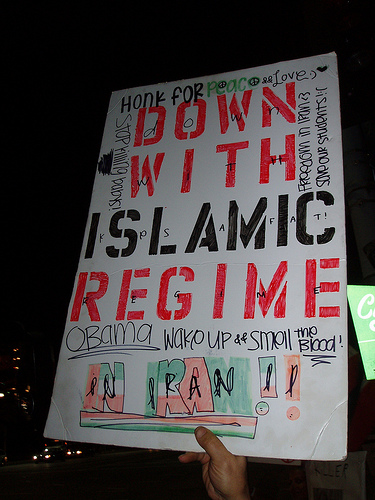 It is time for America, the West and democratic Arab countries to bring Regime Change in Iran, and sow the seeds of Resistance in Iran by encouraging, inspiring and supporting Uprising and Insurrection in Iran against the despotic Ayatollah Khamenei and his autocratic Mullahs. It may well be the only way to prevent a strike by the Israelis on Iranian nuclear assets, who fear nuclear weapons in the hands of the Mad Mullahs, will lead to another Holocaust of the Jewish Race.
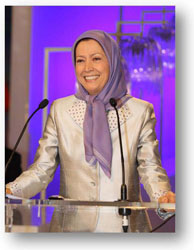 And this time America and the West must show total support and solidarity with the Persian people. Maryam Rajavi is the People’s Choice to be the President Elect of Iran once the Mullah Regime is overthrown.
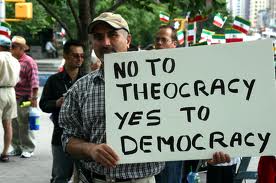 America and the West should step up its campaign of destabilizing Khamenei and the Mullahs by means of Satellite TV Channels of bringing the Truth and Hope direct to the Iranian people, sabotage, electronic jamming and bugging of its military and nuclear facilities, and increasing the severity of economic sanctions on the Islamic Regime. By provoking Insurrection in Iran, the West would redress the balance that been tilting in favor of the Iran/China/Russian Axis, terminate the nuclear quest and despotic rule of the Mullahs, and start the process of freeing Iranians from Radical Islam and Sharia Law, and return Iran to Persian and Secular Rule.


