Showing posts with label Iran. (PMOI/MEK). Show all posts

Thursday, September 7, 2017

After Her Election as PMOI/MEK Secretary General, Zahra Merrikhi Pledges to Bring Freedom to Iran


Zahra Merrikhi, the new PMOI Secretary General


Maryam Rajavi: This election will break the spell of repression and heralds the overthrow of the mullahs’ religious fascism

The People’s Mojahedin Organization of Iran, (PMOI/MEK) held its annual Congress simultaneously in Tirana and five other countries. On the PMOI’s 52nd founding anniversary, the Congress elected Ms. Zahra Merrikhi as its new Secretary General. Ms. Zohreh Akhyani, the Secretary General since 2011, chaired the Congress.
According to the PMOI’s bylaws, the Secretary General is elected to an extendable term of two years. The election is held in three phases. In the first phase, members of the PMOI Central Council, and in the second the organization’s officials and cadres in different departments, cast their votes in secret ballots. In the third phase, at the PMOI Congress, all members vote by raising their hands.
In the first phase, on August 20, 2017, Ms. Merrikhi was elected from among 12 candidates by a majority of the Central Council members. The four leading candidates were put on the ballot for the second phase, which was held on September 3, 2017. Ms. Merrikhi received a majority of the votes cast in ten different PMOI centers. In the final phase, during the PMOI Congress, Ms. Merrikhi was unanimously elected Secretary General.

  Ms. Zahra Merrikhi, the new PMOI/MEK Secretary General
 Ms. Zahra Merrikhi, the new PMOI/MEK Secretary General pledging oath to the Holly Qoran

Previously, Ms. Merrikhi was coordinator for the offices of Mrs. Maryam Rajavi, the President-elect of the National Council of Resistance of Iran (NCRI), and Vice-President of the PMOI’s Central Council.
Born in 1959 in the city of Qa’emshahr in the northern Province of Mazandaran, Ms. Merrikhi became acquainted with the PMOI during the 1979 anti-Monarchic Revolution and joined the PMOI after the Shah’s overthrow. She was soon appointed head of the women’s section in Qa’emshahr, and later became a member of the editorial board of the PMOI publication in Mazandaran, called Talavang.
In 1981, she was transferred to Tehran and acted as liaison between the PMOI and its branches in the forests of northern Iran. In 1984, she moved to PMOI bases in the border region with Iraq, and a year later became a member of the Central Council.
Her younger brother, Ali Merrikhi, was murdered by the Islamic Revolutionary Guards Corps (IRGC) in 1988.
Ms. Merrikhi oversaw PMOI branches in Scandinavia and Germany for some time. In 1991, she became a member of the Executive Committee and was later appointed head of Radio Mojahed, Simay-e Moghavemat (the Iranian Resistance’s television network) and the publication Mojahed.
She became a member of the NCRI in 1992 and was appointed Chairwoman of the Public Affairs Committee.
Ms. Merrikhi had been the coordinator of the offices of Mrs. Rajavii since 2003 and the Vice-president of the PMOI’s Central Council since 2004.
Following her election as Secretary General, Mrs. Merrikhi was sworn in, placing her hand on the Holy Quran and paying her respects to the Iranian flag and PMOI emblem. She pledged to remain faithful to the enormous responsibilities with which she has been entrusted. Ms. Merrikhi vowed to devote all her abilities and those of the PMOI as a national treasure of the Iranian people, to establish freedom and democracy in Iran.

  Ms. Zahra Merrikhi paying respect to the PMOI Emblem and Iranian flag
 Ms. Zahra Merrikhi paying respect to the PMOI Emblem and Iranian flag

The new Secretary General expressed her appreciation for the efforts of her predecessor, Ms. Akhyani, and Ms. Mojgan Parsai, the President of the PMOI’s Central Council. She lauded their efforts and those of other PMOI officials over the past 14 years, during one of the most dangerous and tortuous periods of the Organizations history in camps Ashraf and Liberty.
“Today, the PMOI, with the help of the Iranian people, is prepared as never before to overthrow the clerical regime,” Ms. Merrikhi said, adding that the PMOI has now 18 co-Secretaries General (including seven former Secretaries General). Mr. Merrikhi also introduced Narges Azodanlou, 36, Rabi’eh Mofidi, 35, and Nasrin Massih, 39, as new deputies to the Secretary General.

  The Grand Congress of the PMOI/MEK held in Albaian capital, Tiran on the 52nd founding anniversary of the organization
 The Grand Congress of the PMOI/MEK held in Albaian capital, Tiran on the 52nd founding anniversary of the organization

In congratulating the election of Ms. Merrikhi as the new PMOI Secretary General, Mrs. Rajavi described it as a brilliant election, embodying the height of democracy, cohesion, and growth in the PMOI. It heralds the breaking of the spell of repression which will lead to the overthrow of the religious fascism ruling Iran, she added.
The People’s Mojahedin Organization of Iran
September 6, 2017


Thursday, August 17, 2017

Senior US Senators Meet Iran Opposition Leader In Albania


NCRI
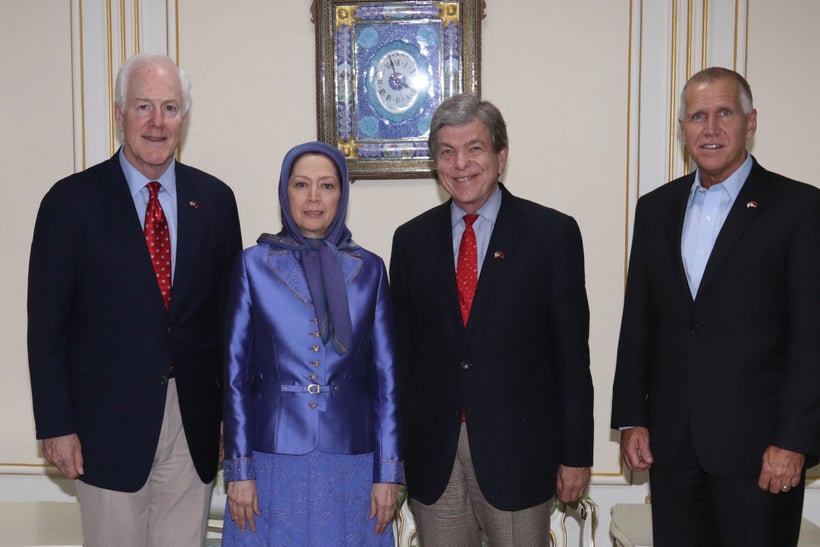
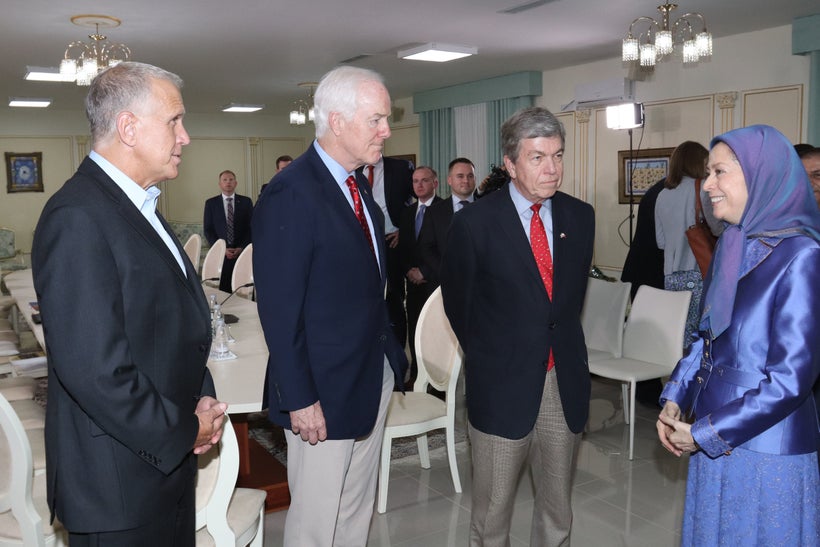
Tirana, Albania, August 12, 2017 - Mrs. Maryam Rajavi (left), the President-elect of the National Council of Resistance of Iran meeting a senior delegation from the United States Senate. The two sides discussed the situation of members of the Mujahedin-e Khalq in Albania and the recent developments in Iran and the Middle East.
While August seems usually a passive time of the year in politics, it has been quite the opposite for Iran and the wide variety of developments around this controversial international dossier.
A senior delegation of United States Senators travelled to Tirana, the capital of Albania, today, August 12, 2017, to meet the Iranian opposition leader Maryam Rajavi, who heads the National Council of Resistance of Iran.
The delegation, Senators Roy Blunt, Vice President of the Republican Conference, and member of the Appropriation, Select Intelligence, Rules and Administration, and Commerce, Science, and Transportation committees; John Cornyn, the Majority Whip, and a member of the Judiciary, Select Intelligence, and Finance committees; and Thom Tillis, a member of the Armed Services, Judiciary, Banking, Housing and Urban Affairs and Veterans’ Affairs committees, also visited members of the People’s Mojahedin Organization of Iran (PMOI/MEK) in the Albanian capital.
NCRI
Tirana, Albania, August 12, 2017 - Mrs. Maryam Rajavi (center), the President-elect of the National Council of Resistance of Iran meeting a senior delegation from the United States Senate. From right: Senators Thom Tillis (R-NC), Roy Blunt (R-MO), and John Cornyn (R-TX).
The NCRI is a political coalition calling for regime change in Iran and considered the main threat to Tehran’s mullahs. The MEK is the main member of this coalition of a variety of Iranian dissident groups and individuals.
“Led by Senator Blunt, the delegation congratulated the safe and secure relocation of all Camp Liberty residents outside of Iraq and wished them success in their struggle for democracy and human rights in Iran,” according to an NCRI statement.
Rajavi expressed her gratitude for the tireless efforts of the U.S. Senate, particularly Senator Blunt, regarding the protection of thousands of MEK members in Iraq, and their safe relocation to Albania.
Senator Blunt was among several American dignitaries, including senior former officials, who at a July 2014 Senate briefing strongly condemned Iran’s highly destructive role in Iraq. While describing Tehran as part of the problem plaguing Baghdad and the entire country, Senator Blunt joined the initiative in demanding the urgent transfer of PMOI/MEK members stationed in a former US military base known as Camp Liberty near the Iraqi capital.
Senator Blunt and his colleagues John McCain (R-AZ) and Jeanne Shaheen (D-NH), and former Senator Carl Levin had urged former Secretary of State John Kerry to “press for the protection of Camp Liberty and to expedite the resettlement of the Camp Residents to countries outside Iraq, including the United States.”
NCRI
Tirana, Albania, August 12, 2017 - Mrs. Maryam Rajavi (center), the President-elect of the National Council of Resistance of Iran meeting a senior delegation from the United States Senate. From right: Senators Roy Blunt (R-MO), John Cornyn (R-TX), and Thom Tillis (R-NC).

source : Senior US Senators Meet Iran Opposition Leader In Albania

Tuesday, August 15, 2017

Iran: Call to Save 7 Prisoners on the Verge of Execution


Seven prisoners sentenced to death in Gohar Dasht (Rajaieh Shahr) Prison in Karaj, have been transferred to solitary confinement. These victims are faced with an imminent death threat. Mehdi Bohlouli, who is now on the verge of execution after serving 15 years of imprisonment, was only 17 when arrested and this is the fourth time he has been transferred to solitary confinement for implementation of the death sentence.
Taking prisoners to the gallows to witness the shocking scene of the execution of other prisoners is a common practice of torture in the prisons of Iranian regime.
Transferring the young prisoner, Mehdi Bohlouli for execution is taking place while the execution of Alireza Tajiki, a young prisoner who was 15 years old at the time of his arrest, sparked a wave of hatred inside and outside of Iran, and international human rights organizations called it shameful and shocking. Alireza Tajiki was hanged on August 10 after serving six years in prison under torture for compulsory confessions, and while his family's repeated requests for a retrial was ignored.
The execution and torture machine of the regime, which is a world record holder, on the number of executions per capita and one of the few juvenile executioners, has accelerated after the sham presidential election. Only in July 2017 there has been a rare record of 101 recorded hangings. The actual number of executions is likely to be higher, since it does not include the number of secret executions.
The Iranian resistance calls for urgent intervention and action of the international bodies and human rights organizations to stop the death sentences of these seven victims and the abolition of their death sentences, as well as the protest and condemnation of governments to the new wave of executions in Iran.
Secretariat of the National Council of Resistance of Iran
August 14, 2017

Monday, July 31, 2017

MEK'S POPULARITY AMONG IRANIAN YOUTH, REGIME'S NIGHTMARE


CONTRARY TO IRAN LOBBY CLAIMS, REGIME CHANGE DOES NOT END IN WAR

One of the great falsehoods of the Iran lobby and the appeasers of the clerical regime in Tehran is that any effort at regime change would inevitably lead to war. This by-line can be seen in every article by the Iran lobby and the appeasers attempting to underscore the growing global support for the Iranian opposition (MEK/PMOI) and the Iranian people’s quest for regime change.
History teaches us though that the longevity of any regime born out of violent conquest is ultimately short-lived.
The Iranian regime that was born out of a revolution overthrowing the Shah, which was in turn hijacked by the mullahs and turned into a religious oligarchy. The original aim of the revolution was the formation of a secular, pluralistic democracy. That dream still exists in the hearts and minds of the overwhelming majority of the Iranian people and resonates in the various forms of protest in Iran, despite the repressive measures by the regime. Therefore, the call for “regime change” is primarily the Iranian people’s demand.

Since the early days after the 1979 revolution, the mullahs have relied on the typical tools of oppression to keep their grip on power, including the creation of a paramilitary and judiciary system so vast, it touches nearly every sector of Iranian society. At the same time, the Iranian regime and its apparatus (including the regime lobbies and appeasers) have been quick in attacking any publication or personalities who dare speaking about the Iranian people’s quest for freedom and particularly “regime change” in Iran. It goes without saying that those more in line with the regime have targeted MEK/PMOI, since MEK/PMOI is the most dedicated and the organized opposition with extensive routes and support at home, that can materialize the regime change. The people’s Mojahedin Organization of Iran, PMOI (usually referred to as MEK) has therefore been the subject of dubious propaganda campaigns by the Ministry of Intelligence and Security (MOIS) at home and by the regime lobbies and appeasers abroad. The idea is to say that there is no democratic alternative to this regime. Hence, the only option is to put up with the dictatorship in Iran, otherwise there will be war!
A look at the back ground of the MEK/PMOI, Iran’s democratic opposition can be helpful in shedding light on the reasons for sometimes unprecedented campaigns against them. The People’s Mojahedin of Iran (PMOI/MEK) is the oldest, largest, and contrary to the mullahs’ propaganda, the most popular resistance organization in Iran. The PMOI/MEK was founded in September 1965 by three Iranian engineers, who sought to replace the Shah’s repressive monarchy with a democratic government.
The PMOI/MEK enjoys broad popularity in Iran because of its longstanding support for democracyand its modern interpretation of Islam. The MEK/PMOI believe Islam is inherently tolerant and democratic, thus fully compatible with the values of modern-day civilization. This vision is in fact the cure to the growing expansion of Islamic extremism funded and supported by the mullahs in Iran.

The MEK/PMOI participated in a united front against the Pahlavi monarchy, which violently opposed democratic reforms and had one of the worst human rights records in the world. After the Shah fled Iran, the MEK/PMOI worked to establish a democratic government, but Ayatollah Khomeini hijacked the Revolution and instead created an Islamic theocracy.
The MEK/PMOI shifted course and directed its opposition against the Ayatollah, continuing its struggle to restore democracy in Iran. In June 1980, the PMOI/MEK organized a rally in Tehran to protest Khomeini’s escalating despotism. More than 200,000 people participated in the demonstration.
With each passing day, the PMOI/MEK gained strength and, in July 1980, Khomeini openly considered the possibility of defeat, stating, “Never have I so much feared the Islamic Revolution end in failure.” He lashed out at the PMOI/MEK, declaring the resistance organization as the main enemy. Khomeini said, “Our enemy is neither the United States, nor the Soviet Union, nor Kurdistan, but sitting right here in Tehran under our nose [the PMOI/MEK].”
Revolutionary Guards escalated their attacks on the PMOI/MEK, which continued to promote its pro-democracy campaign. The turning point came on June 20, 1981. The MEK/PMOI organized rallies across Iran to protest Khomeini’s oppressive rule. More than a half million Iranians attended the demonstration in Tehran.

On direct fatwa by Khomeini, the Hezbollah blocked off streets and fired weapons into the growing crowds, killing hundreds of Iranians and injuring many more, with thousands arrested. The reign of terror had begun. The following day, Khomeini’s henchmen executed hundreds of PMOI/MEK supporters who had been arrested, including young girls.
The bloodbath was unrelenting. In the months and years that followed, more than 120,000 PMOI/MEK members and supporters were killed by Khomeini and the ruling mullahs. In only one occasion in summer of 1988, over 30,000 political prisoners (mainly members and supporters of the MEK/PMOI) were mass murdered in Iran, based on a direct fatwa of the mullah’s Supreme Leader, Khomeini. The savagery removed any legitimacy the Islamic Republic may have once had. The regime is now viewed by the people of Iran as fascist, maintaining power through fear and brutality.
Members and supporters of the PMOI/MEK have suffered greatly in their struggle to restore democracy to Iran. Iranians respect the many sacrifices made by the MEK/PMOI and revere its martyrs.
Through the years, the MEK/PMOI has been steadfast in its battle to rid Iran of the mullahs’ nightmare regime, overcoming severe hardships and setbacks. Contrary to the Iranian lobby’s claim, the support by the Iranian people for the PMOI/MEK is also steadfast. The resistance organization has earned their respect and trust and it gives voice to their aspirations for a free and democratic Iran. This can be seen in the latest activities of the supporters of the MEK/PMOI, in Tehran and other major cities across Iran, during the election show and in solidarity with the Free Iran gathering in June and July 2017.
Hundreds of video clips and photos of banners and placards hanging from pathways over highways and auto routes on billboards, or in the shape of graffiti on walls in Tehran and other major cities, are published on various Telegram and YouTube channels, showcasing the vast magnitude of these activities. This is while activists have been prosecuted and some even executed for far less “crimes” in the past decades. To an extent that the regime’s supreme leader had to change plans and give in to a second term for Rouhani as president to end the spreading protest and infightings in fear of a similar 2009 uprising that could sweep his regime, was the result of the MEK/PMOI’s presence and their activities.

Activities seen in cities across Iran during the election season, were all following a call made by the People’s Mojahedin Organization of Iran (PMOI/MEK), who spread the slogan “My vote is regime change” across the country. This brought the mullahs to the conclusion that the dangerous consequences of deepening divides amongst the regime’s senior elite were paving the path for nationwide uprisings similar to those seen in 2009. As a result, the mullahs’ ruling elite decided to quickly bring an end to the election farce in the first round and prevent any further opportunities for protests and possible uprisings.
Dr. Rafizadeh, a leading Iranian-American political scientist, president of the International American Council on the Middle East, and best-selling author in an opinion piece in Huffington post publishing 8 video clips of MEK/PMOI activities inside Iran, wrote: “The activists of the network of the Iranian opposition movement, the National Council of Resistance of Iran and its group the Mujahedin-e Khalq (MEK/PMOI), inside Iran have been engaged in an extensive campaign nationwide, calling on Iranians to boycott the elections.
Their activities involved hanging huge portraits of the Iranian opposition leader, Maryam Rajavi from overpasses or bridges in major freeways in Tehran and other cities, posting her pictures on walls in different streets and other public locations, such as in the bazaar or outside the paramilitary Bassji headquarters, or placing them on the windshields of cars, and distributing flyers and T-shirts with the MEK/PMOI emblem and calling for government change.”
He concludes: “Finally, from my perspective, it is critical to point out that Iranian leaders fear the soft power of oppositional groups more than the military and hard power of foreign governments. That is why Iranian leaders and media outlets normally react forcefully and anxiously to activities by the opposition, such as the recent critical move where Senator John McCain (R-AZ), Chair of the Senate Armed Services Committee, recently met with Mrs. Maryam Rajavi, the President-elect of the National Council of Resistance of Iran (NCRI), in Tirana, Albania. Iran’s oppositional groups can be a very powerful tool to counterbalance the Islamic Republic.”
Some of the MEK/PMOI affiliates activities reflected on the opposition media outlets include:
In Tehran: Haghani cross section, activists of PMOI/MEK put up a poster in a major cross section reading: “My Vote Overthrow, Big No of the People of Iran to Election Farce in Clerical Regime. Down With Khamenei, Hail to Rajavi (the leader of Iran opposition).”

Iran, Tehran and Azarbaijan, in the run - up to the sham presidential election, activists of MEK/PMOI in the capital Tehran, and Azarbaijan province Notrh in Western Iran put up posters against Iran regime's sham election written: Our vote is for Maryam Rajavi.
Iran, Uremia , in the run - up to the sham presidential election, activists of MEK/PMOI in Uremia Azarbaijan province North- West Iran put up posters against Iran regime's sham election written: Our vote is for Maryam Rajavi.
Iran, Marvdasht, in the run - up to the sham presidential election, activists of MEK/PMOI in Fars province Central Iran put up posters against Iran regime's sham election: “No to Rouhani the imposter , No to Raisi the murderer.”
Supporters of the People's Mojahedin Organization of Iran (PMOI / MEK) have filmed and photographed themselves holding up photographs of Iranian Resistance President-elect Mrs. Maryam Rajavi and slogans in support of the 'Free Iran' rally.
Another hallmark for understanding the extent of activities of MEK/PMOI and its popularity among youth, is the recent expressions of concerns followed by crackdowns on the youth under the pretext of cybercrimes. Recently, Abdolsamad Khoramabadi, regime’s deputy public prosecutor said that cyberspace have become extremely worrisome for Tehran. Referring to “Telegram”, by far the most popular social media platform in Iran with over 20 million users, he said:
“More than 30% of these Telegram channels are involved in criminal activities against the country’s security and disrupting the entire nation.”
“The MEK Telegram channel inside Iran is very active… all the regime’s opponents are providing the people all their books and written material through this online platform. If you sought to purchase them you have to pay huge amounts of money. If you wanted to publish a book, it would be very demanding, but on the Internet it is quite easy,” added the regime’s deputy public prosecutor.
The Iranian regime has time and again negotiated with Telegram’s managers to block the MEK/PMOI website and associated channels, only to be rejected each time. This has left Tehran facing an impasse.
Either accept the MEK/PMOI’s vast network with all its grave consequences or pay the ultimate price of blocking Telegram. The latter, however, will raise even more dissatisfaction that can even trigger a protest.
The 2009 uprisings and massive protests that were viciously put down sent shivers down the mullahs’ spines and served as a sharp reminder that their hold on power is tenuous at best. Hence, they actively repress a free press, continually arresting and imprisoning journalists, editors, photographers, and now bloggers, who voice, print, transmit or illustrate any hint of dissent.
Dictatorships that stand on fragile ground are always more oppressive. The Iranian regime fits that bill to a T.
In addition to using blunt force on people, the regime invests heavily in the massive propaganda effort it mobilizes through state-controlled media and via its lobbies and paid agents abroad, in order to discourage more support for the MEK/PMOI, which is the main driver for regime change in Iran. The extent of the anti MEK/PMOI propaganda has increased, particularly after the July 1, 2017 gathering in Paris, which had a clear message: “Regime change in Iran is within reach”. Some 100,000 Iranian diaspora and supporters of MEK/PMOI gave energy to it. A nightmare for the criminal mullahs that cannot be avoided.
This is why it serves the regime’s purposes to continually dangle the threat of war over the heads of its people. It also helps the Iran lobby’s PR efforts to cast Iran like some poor, defenseless nation under threat by the big bad U.S. and its allies, such as Saudi Arabia or the Iranian resistance movement, the MEK/PMOI.
Trita Parsi, the head of the National Iranian American Council and staunch advocate for the Iranian regime, appeared on Bloomberg to beat the war drum again, as well as attack the Trump administration for not living up to the Iran nuclear deal, even though Secretary of State Rex Tillerson announced the renewal of the compliance certification for another 90 days.
But the Trump administration also is asserting that Iranian regime’s development of ballistic missiles; support of terrorism and militancy; complicity in atrocities by the government of Syrian dictator, Bashar Assad; cyberattacks on the U.S.; and other actions “severely undermine the intent” of the nuclear accord.


Based on those actions, Trump is announcing an additional package of sanctions against 16 Iranian entities and individuals found to be supporting Tehran’s activities in the region, according to the Washington Times.
The real threat to the Iranian regime though lies not within sanctions, but in the simple acts of defiance that the Iranian people undertake themselves, such as the hanging of banners on Tehran overpasses bearing the image of MEK/PMOI leader Mrs. Maryam Rajavi; an act punishable by death if the perpetrators were caught.
The regime is also threatened by every protest over low wages or unsafe working conditions. In many ways large and small, the process of regime change can happen slowly, methodically, and inexorably.
Mrs. Rajavi, in a recent speech at the annual gathering of the Iranian resistance movement and supporters of MEK/PMOI, opined that the movement did not require outside assistance from governments, such as the U.S., to succeed. It only needed the recognition by governments to be empowered.
The heavy lifting of pushing for regime change must come from within Iran from the Iranian people, said Mrs. Rajavi.
So long as the Iranian regime keeps trying to place a tight lid on the simmering pressure for change by the Iranian people, the harder it will be to prevent the inevitable.


Monday, July 24, 2017

A democratic alternative to the Iranian regime – 'Free Iran' rally highlights MEK's role in Iranian resistance


During the 'Free Iran' rally in Paris on July 1, the mood was festive and clearing upbeat, as speakers discussed the movement of MEK members from Iraq to Albania.
But many of the speakers and delegations also spoke of the real possibility of regime change in Iran, as they noted major changes on the international scene. Speaker after speaker from the United States pointed to the new policies of the Trump administration, while others acknowledged the Obama administration for its efforts to remove the MEK from the terrorist list.

Still, the highlight of the event was the keynote address by Maryam Rajavi, the National Council of Resistance of Iran (NCRI) President-elect. She noted that there was an alternative to the current regime and its extremism.
"Since last July, the Iranian Resistance has hoisted the banner of seeking justice for the victims of the massacre of political prisoners 29 years ago, turning it into the main focus of political discourse in Iran today," said Rajavi.
She noted that in the recent Iranian elections, which many speakers called a "sham", that the slogan of the resistance was "No to the executioner, no to the charlatan". It was a slogan that was widely embraced by the Iranian people, and referenced the attempt by Khamenei to elect Raisi, a member of the death commission in the 1988 massacre.
Rajavi said there is alternative to the Iranian regime and it is the Iranian resistance.
"It is relying on political prisoners, who reaffirmed their support recently for this gathering from the depth of their cells and dungeons. It is relying on women, workers, teachers, professionals, and selfless youths. It is relying on their unsparing love and generous support, those who barrow money and sell their houses and properties to help keep this Resistance independent, strong, and solidified," said Rajavi.
She noted that the Resistance has continued to fight for freedom and stood by what it has said and promised.
"The Iranian nation is proud to have created a democratic alternative through resistance and great suffering and sacrifice. This decisive asset,…did not exist at the time of the Shah," said Rajavi. She acknowledged that this left a vacuum that allowed the regime to grow and take root.
As part of her discussion of the Resistance, she acknowledged the contributions of Massoud Rajavi, who has been a leader in the Resistance, but also active in encouraging those in Camp Liberty to keep fighting and maintain the struggle for freedom.


FORMER INTELLIGENCE MINISTER TALKS ABOUT 1988 MASSACRE OF MEK PRISONERS IN IRAN


By INU Staff
INU - Ali Fallahian, a former Intelligence Minister of Iran, participated in an interview with Tarikh Online – a state-affiliated news website, earlier this month. He admitted that the Supreme Leader at the time, Ayatollah Khomeini, ordered the execution of anyone linked to the Iranian opposition (MEK) in a fatwa in 1988.
During the summer of 1988, more than 30,000 political prisoners, most of whom were members or supporters of the People’s Mojahedin Organisation of Iran (PMOI or MEK), the main Iranian opposition group, were executed.
He said that the fatwa ordered the execution of the MEK members who insisted on maintaining their beliefs. To deal with the logistics of it, a commission was formed, he said. This is what has become known as the “Death Commission”. Fallahian said that the purpose of the commission was in actual fact to see who would be pardoned instead of being executed.
He explained that the people could have escaped execution by saying that they no longer hold their beliefs and do not support the MEK or any other opposition. If they declared their commitment to the Supreme Leader they would have remained alive.
Mr. Hossein-Ali Montazeri released an audio recording of him warning the other members of the death commission about what they were partaking in. He said that such an act would go down in history as an unforgettable and horrific event. He was also concerned that it was not a good image of Islam. Fallahian said that he also clashed with Khomeini on other matters, and he was instructed to carry out his religious duties, in this case to participate in the 1988 massacre, without any regard for “history’s judgement”.
The Iranian regime has commented that the people who were executed in 1988 were armed when they were arrested, but Fallahian explained that this was not the case. Not all of the people who died were part of armed rebellion activities. Fallahian said that they did not distinguish between those who were armed and those who were not – if they were faced with a member of the MEK then they were treated as if they were armed.
The interviewer, clearly shocked by what they were hearing, asked Fallahian to clarify what he said. They asked him that if someone was carrying a MEK newspaper, would they have been arrested. Fallahian said yes, because they were part of the MEK.
The people of Iran are still waiting for justice despite repeated calls by the international community.


وطن امروز: ایران، پاسپورت پیشکش، اعتبار گذرنامه سبز هم رفت

ایران: پاسپورت پیش کش اعتبار گذرنامه سیز هم رفت  پاسپورت پیشکش اعتبار گذرنامه سبز هم رفت روزنامه حکومتی وطن امروز وابسته به باند ...